Energiewerk Graz & EKV
Part of the district heating supply strategy: local energy generation, sector coupling and sewage sludge utilisation.
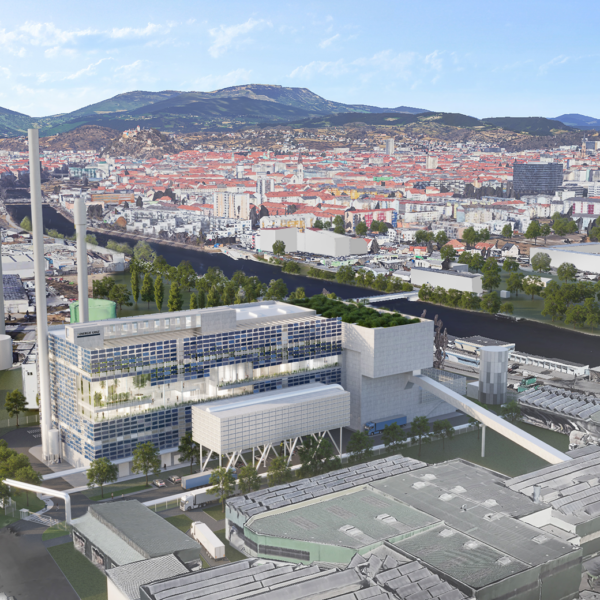
The projects:
The district heating supply in the greater Graz area has expanded in recent years. The City of Graz, the Province of Styria, Holding Graz, Energie Graz and Energie Steiermark are pursuing measures for the future development of the district heating system in the greater Graz area. The City of Graz, the Province of Styria, Holding Graz, Energie Graz and Energie Steiermark have been working together for years on the further development of district heating in the greater Graz area.
Despite these measures, natural gas is currently an essential primary energy source for the district heating supply in the greater Graz area. In addition to environmental and energy supply considerations, alternative projects are intended to reduce reliance on natural gas imports, especially in view of the current geopolitical situation: The operating times of the existing gas boiler plants at the Puchstraße site can be reduced by Energiewerk Graz.
The “Energiewerk Graz” and “Energetic Sewage Sludge Utilisation Plant in Gössendorf” (EKV) projects are key components of the future district heating supply in the greater Graz area.
In the first phase, a feasibility study was carried out; in the second phase, preparations are now being made for the environmental impact assessment of the Graz energy plant, which will start in 2023 and will examine aspects relevant to the environment and residents. If the results of the assessment are positive, a construction decision will be made and the project can be implemented from 2027 to 2029.
The site of the district heating power plant in Graz (Puchstraße) was identified as the most suitable location for the energy plant in Graz. For the energetic sewage sludge utilisation (EKV), the investigation revealed the site of the municipal sewage treatment plant in Gössendorf as the location.